
Winter Averaging

At Lakeway Municipal Utility District (LMUD), customer water use is metered, but wastewater charges are averaged. This means that LMUD customers are charged for the amount of water passing through their assigned water meter during any given billing cycle. However, the water flowing out of their home or place of business is not metered, but must also be treated by LMUD, therefore charges for this service must be calculated another way. LMUD determines their customers’ charges for wastewater service based on “Winter Averaging” which takes place November through February each year. What’s Winter Averaging? First, let’s discuss the basics:
Plumbing 101
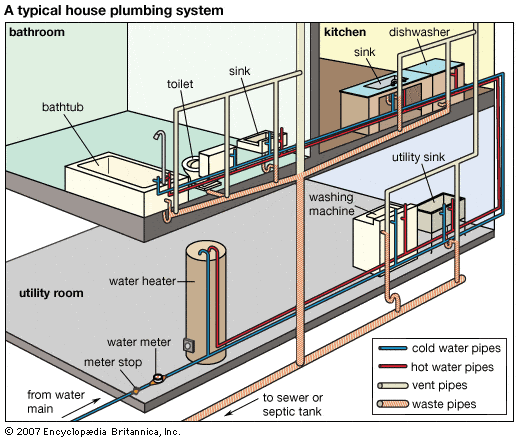
There are at least two sets of separate plumbing subsystems running through every home or place of business: pipes that supply clean, treated water into the facility and those that carry used water (known as “wastewater”) out. Both of these systems require the water to be treated. The clean water originates at LMUD’s water treatment plant where certified water operators convert raw water from Lake Travis to drinking water standards. The wastewater, if not managed by an onsite sewage facility (septic system), is directed to LMUD’s wastewater/recycled water treatment plant where the soiled water is treated to the highest standards required for safe reuse in irrigation systems. LMUD charges their customers for the water they use from the water treatment plant by installing a water meter at the edge of each property; because there is not a separate meter on the wastewater lines, an alternate method for tracking usage is needed. Many utilities utilize what is known as “Winter Averaging” to estimate this usage from year to year.
This period of outdoor low usage is when we implement “Winter Averaging” to get a better average for how much of our customers’ water use is directed to our wastewater treatment plant.
To be clear, Winter Averaging does not affect the customer’s clean (potable) drinking water volume charges.
Tracking Wastewater Volume
Think of all the ways you use water in your house: bathing, flushing the toilet, washing clothes and dishes, cooking, etc. Where does all of this water go? Now, think of all the ways you use water outside the house: to irrigate landscaping, wash the car, fill the pool, etc. Where does all of this water go? Typically, your indoor water use runs into your wastewater plumbing subsystem and eventually to our wastewater treatment plant. The water you use on the outside of your house, however, either seeps into the ground or is evaporated. Think about what time of year your outdoor water use is highest. Summer, right? When temperatures are high. Outdoor use is minimal in winter because most landscaping is dormant and outdoor activities are minimal. This period of outdoor low usage is when we implement “Winter Averaging” to get a better average for how much of our customers’ water use is directed to our wastewater treatment plant.
What is “Winter Averaging”?
Now that we understand some background, we can get into the details of Winter Averaging. Since we bill every two months, LMUD’s customer water meters are read two times during the period of Winter Averaging which spans November 1 through March 1 each year, so if customers minimize their water during November AND December or January AND February, they can greatly decrease their water bills for the following year!
Each December bill is where you will see your new wastewater rates (a base charge and volume charge). These same rates will appear on all of your bills until next December (they will not change during each bill cycle, like your water volume charge will). Since we do not have a separate meter to capture your wastewater volume, the volume charge was calculated based on your water usage during last year’s “winter averaging” period.
We look at the water usage from your two bill cycles with water usage from November through February (bills sent out in February and April) and we use the lower of the two usages. The exception if one is zero, then we will use the other. The minimum we bill is 2,000 and the maximum is 30,000 gallons per billing cycle. New customers are billed our customer average which is 12,000 gallons per billing cycle for at least the first fiscal year.
For example, if the bill you received last February (which includes water usage from the previous November and December) shows 10,000 gallons of water were used at your service address and the bill you received last April (which covers usage from the previous January and February) shows 13,000 gallons of water were used at your service address, then your new wastewater volume charge is based on the 10,000 gallons.
Bills Used to Calculate New Wastewater Charges |
Bills On Which New Wastewater Charges Appear |
|---|---|
|
Feb. 2024 (water usage: Nov. 2023, Dec. 2023) or Apr. 2024 (water usage: Jan. 2024, Feb. 2024) |
Dec. 2024 – Oct. 2025 |
|
Feb. 2025 (water usage: Nov. 2024, Dec. 2024) or Apr. 2025 (water usage: Jan. 2025, Feb. 2025) |
Dec. 2025 – Oct. 2026 |
|
Feb. 2026 (water usage: Nov. 2025, Dec. 2025) or Apr. 2026 (water usage: Jan. 2026, Feb. 2026) |
Dec. 2026 – Oct. 2027 |
See Billing Cycle for additional details on dates.
See Rates for current base charges and volume charges.
Water Vs. Wastewater Charges
To be clear, Winter Averaging does not affect the customer’s clean (potable) drinking water volume charges. Potable water volume charges are calculated by the amount of water flowing into a home or place of business through the water meter assigned to each property. The charge will vary from billing cycle to billing cycle (every two months). However, wastewater volume charges are averaged out to remain the same on each bill cycle for 12 months, starting with the December following the Winter Averaging Cycle in which the new rate was calculated.
Still have questions? Contact us.
 You are now being redirected to the WaterSmart page.