
Gardening for Birds with Native Plants (Video)
Presenter: Chris Gunter, Travis Audubon Society
LMUD Monthly Garden Club presentation, February 9, 2026
Chris Gunter brings over 40 years of birding experience to this presentation, along with more than three decades of service to Travis Audubon Society. A former Travis Audubon Board President, certified Master Naturalist, and Master Birder, Chris blends deep ecological knowledge with practical, real-world gardening advice. In this talk, he explains how native plants create the food, shelter, and structure birds need to thrive—and how even small yards can make a big difference.
What Birds Need
All birds rely on four basic elements:
- Food (especially insects, caterpillars, nectar, seeds, and fruit)
- Water (shallow, clean, and preferably moving)
- Shelter (dense foliage, snags, and layered vegetation)
- Places to raise young (trees, shrubs, grasses, and natural materials)
Why Native Plants Matter
Native plants are:
- Adapted to Central Texas droughts, floods, and soils
- More resistant to pests and disease
- Essential for insect diversity, especially caterpillars
Research by Douglas Tallamy shows that native trees support many species of Lepidoptera (butterflies), like oaks (Quercus) which support over 500 species, while many common non-native ornamentals support few—or none. Where caterpillars thrive, birds follow.
Birds and the Native Plants That Support Them
A key takeaway from Chris’ presentation is the importance of vertical niches, or vegetation layers, which allow many bird species to share the same space without competing:
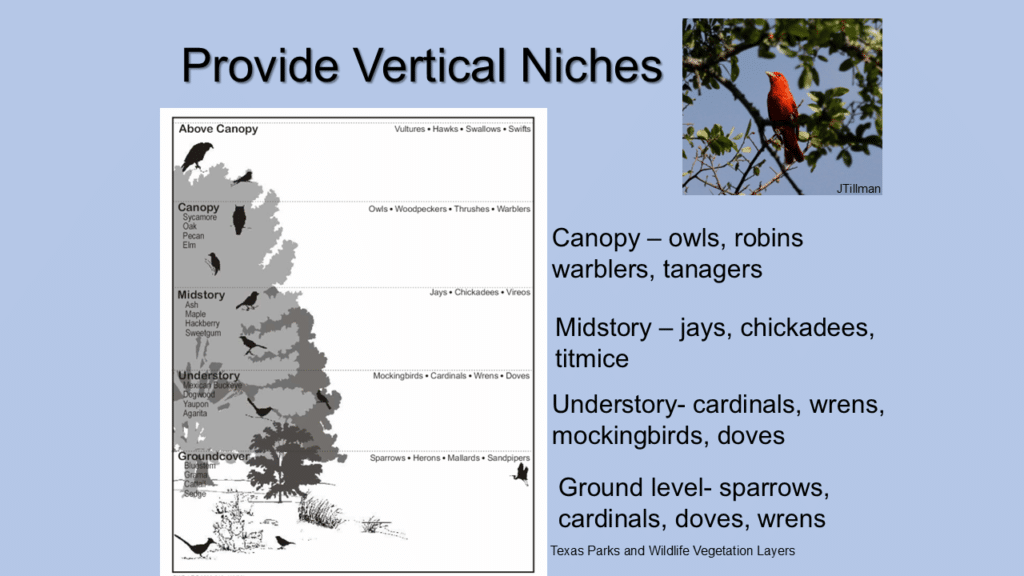
Canopy Layer
Large trees that provide food, nesting sites, and long-term habitat
Key Birds:
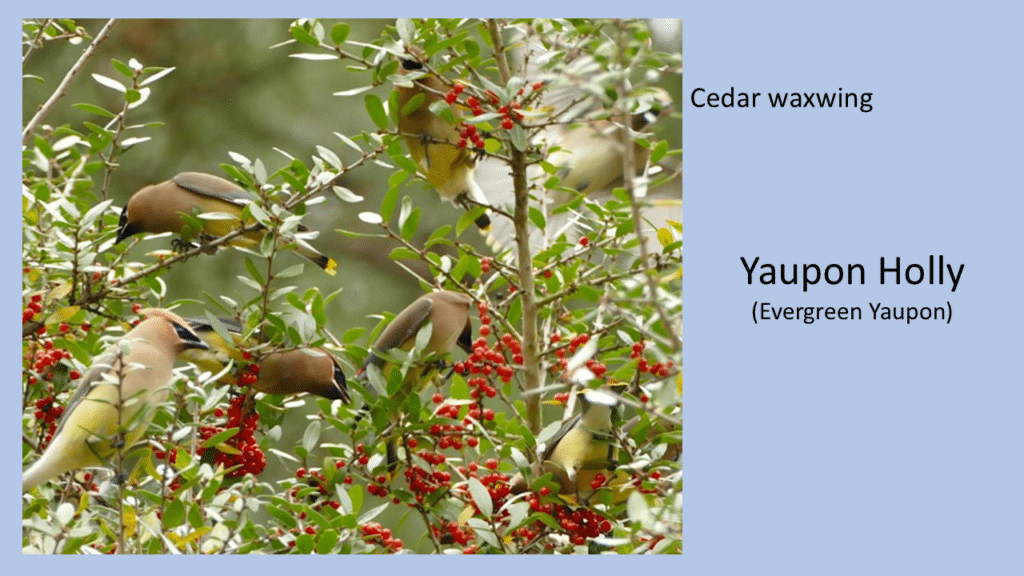
Owls, American Robin, warblers, tanagers, Northern Flicker, Yellow-bellied Sapsucker, Baltimore Oriole, Cedar Waxwing
Native Trees:
- Cedar Elm (Ulmus crassifolia)
- American Sycamore (Platanus occidentalis)
- Bald Cypress (Taxodium distichum)
- Native oak trees, such as the Escarpment Live Oak (Quercus fusiformis)
Tip: Leave dead trees (snags) when possible—woodpeckers, chickadees, wrens, and titmice depend on them.
Midstory Layer
Small trees and large shrubs that offer fruit, cover, and nesting density
Key Birds:
Jays, chickadees, titmice, mockingbirds, cardinals, Baltimore Oriole, Rose-breasted Grosbeak
Native Plants:
- Hackberry (Celtis occidentalis)
- Ashe Juniper (Juniperus ashei)

Bringing birds to your yard offers immense joy, providing natural entertainment, vibrant color, and calming, melodic songs that reduce stress and boost happiness. It creates a deeper connection to nature and acts as a rewarding, educational hobby that supports local biodiversity through natural pest control and pollination.
Understory Layer
Shrubs and perennials that support nesting, insects, and fruit-eating birds
Key Birds:
Cardinals, wrens, mockingbirds, doves, Indigo Bunting, Eastern Bluebird
Native Plants:
- Red Mulberry (Morus rubra)
- Yaupon Holly (Ilex vomitoria)
- Possumhaw Holly (Ilex decidua)
- Mountain Laurel (Kalmia latifolia)
- Flame-leaf Sumac (Rhus lanceolata)
- Red Buckeye (Aesculus pavia)
- American Beautyberry (Callicarpa americana)
Ground Layer
Grasses and flowering plants that support seed-eaters and insects
Key Birds:
Sparrows, goldfinches, doves, cardinals, wrens
Native Plants:
- Coralberry (Symphoricarpos orbiculatus)
- Pigeonberry (Rivina humilis)
- Agarita (Mahonia trifoliolata)
- Turk’s Cap (Malvaviscus arboreus)
- Sages, such as Autumn Sage (Salvia greggii) and Lyre-leaf Sage (Salvia lyrata)
- Native Grasses, such as Switchgrass (Panicum virgatum)
- Sunflowers, such as Common Sunflower (Helianthus annuus) and Plateau Goldeneye (Plateau Goldeneye)
- Purple Coneflower (Echinacea purpurea)
- Texas Thistle (Cirsium texanum)
Chris’s top pick: Turk’s Cap — blooms from early spring until frost and supports birds, pollinators, and insects.
Tip: Leave leaf litter—many insects overwinter there, providing critical food for birds.
Vines & Nectar Plants (Cross-Layer Support)
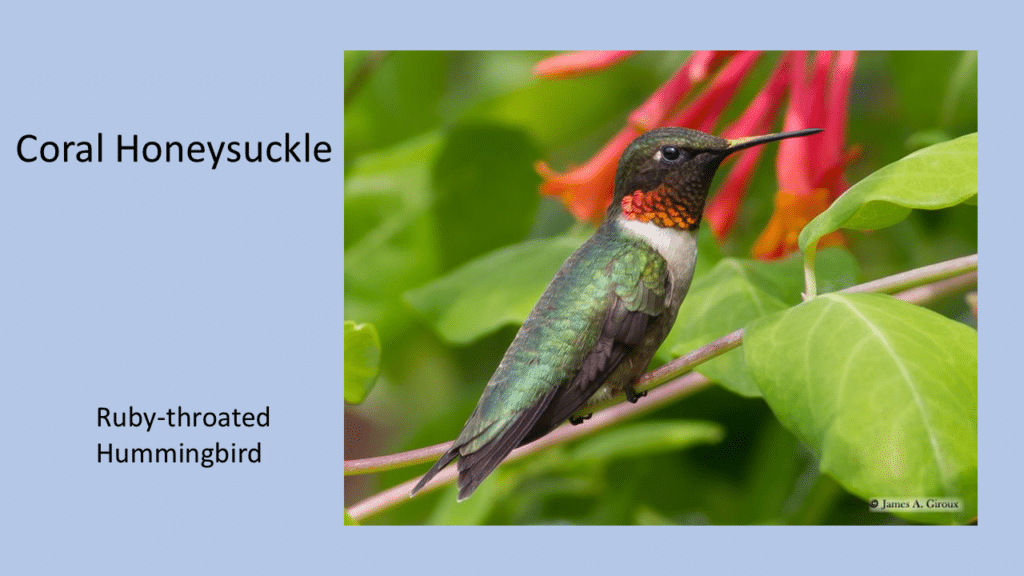
Hummingbirds & Insect-Eating Birds utilize these natives:
- Flame Acanthus (Anisacanthus quadrifidus var. wrightii)
- Coral Honeysuckle (Lonicera sempervirens)
- Mexican Bush Sage (Salvia leucantha)
- Virginia Creeper (Parthenocissus quinquefolia)
Water & Nesting Support
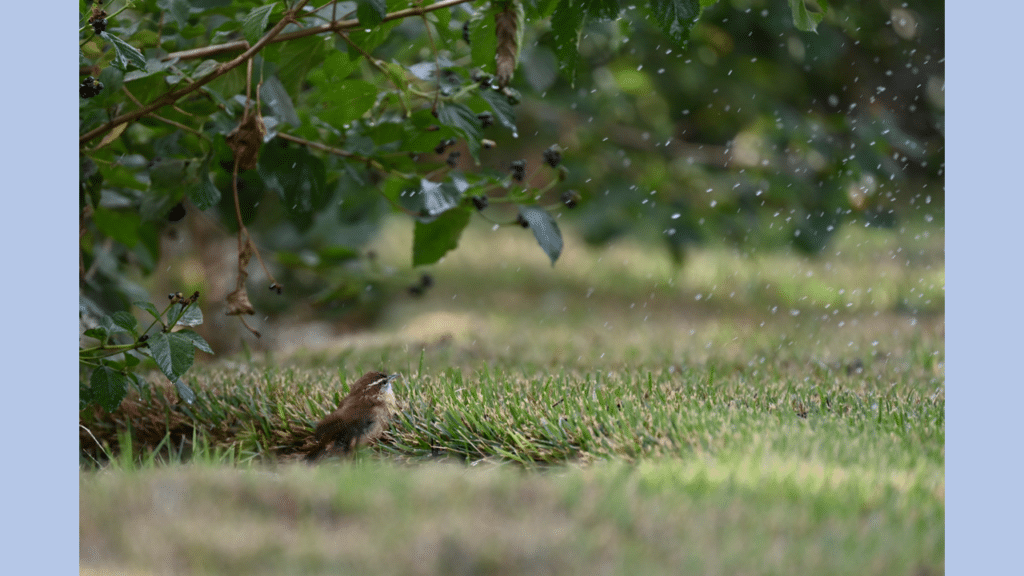
- Use shallow bird baths; moving water attracts larger birds
- Skip gravel—it makes cleaning harder
- It can be as simple as misters and sprinklers
- Leave natural nesting materials: grasses, twigs, bark, vine tendrils, Spanish moss
Big Picture Takeaway
By planting native species across all vegetation layers, gardeners can turn yards and greenbelts into functional bird habitat. Even a few well-chosen plants—especially natives—can support insects, feed birds, and help restore ecological balance in Central Texas communities.
 You are now being redirected to the WaterSmart page.