
Rewilding Our Relationship with Nature
As published in Lake Travis View, August 2025.
What makes a plant a weed? It’s a deceptively simple question with a surprisingly complex answer. For many, the definition is straightforward: a weed is any plant growing where it’s not wanted. But dig a little deeper (pun intended), and you may find that what we call a weed often reflects something more profound: our cultural ideas about beauty, order, and control in the spaces we inhabit. That “weed” may be native to our region: adapted to our climate, beneficial to pollinators, and far more drought-tolerant than the turf and ornamentals we typically value.
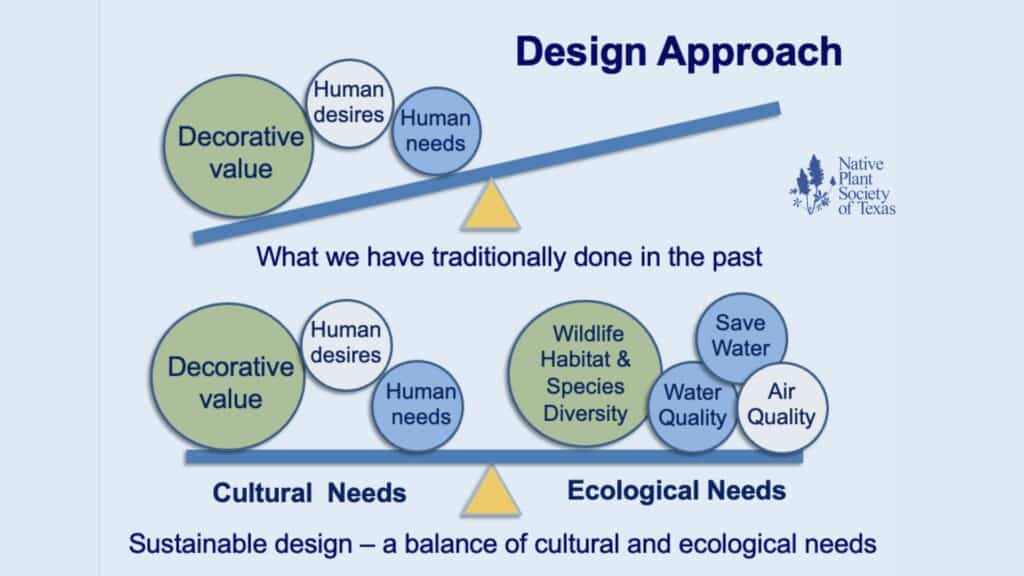
Cultural needs are real. Yards are places where we socialize, where kids run and pets play, and where we express personal taste. Decorative value also matters. Pride in one’s home and curb appeal are valid desires. But those goals can be met without ignoring ecological responsibilities. In fact, the Native Landscape Certification Program from the Native Plant Society of Texas offers a guiding framework for creating landscapes that harmonize human and ecological needs, encompassing the concepts of:
- Ecological Harmony: Functional turf areas can be balanced by weaving in native plantings with structure—paths, seating areas, framed beds—to satisfy both human desires and ecological function. Designing yards with native plants supports pollinators, enriches soil, and sustains wildlife, rather than disrupting local ecosystems. Only small steps are needed to yield meaningful gains: replacing a modest strip of grass reduces water use, planting native shade trees lowers cooling costs, and allowing a milkweed patch helps monarchs thrive. Over time, as more yards adopt this balanced model, cultural norms will shift from manicured uniformity to dynamic, sustainable beauty.
- Resource Conservation: The U.S. Environmental Protection Agency estimates that landscape irrigation accounts for nearly one-third of residential water use across the U.S. During the hot, dry months in Central Texas, outdoor watering can become the biggest single use on a household water meter. That’s not just an expense for homeowners; it strains reservoirs, aquifers, and municipal systems during times when water sources are already stressed. Native plants, by contrast, are adapted to local rainfall patterns and typically need only occasional supplemental irrigation once established.
- Resilience and Self-Sufficiency: A 2025 survey* found that 76% of American homeowners feel pressure to maintain great-looking lawns for curb appeal, spending an average of three hours per week on exterior maintenance. This time is devoted to mowing, watering, fertilizing & pest control, as well as equipment upkeep. With thoughtful preparation and mulching, the natural resilience of native plants requires far less upkeep and far less reliance on fertilizers or pesticides. That means cost savings, healthier gardens, and reduced human effort.
- Biodiversity Enhancement: According to Homegrown National Park (HNP), an organization that aims to save biodiversity one privately owned land at a time, entomologists are seeing notable declines in insect diversity worldwide, caused by habitat loss, introduced species, novel pathogens, pesticides, pollution, and climate change. This negatively affects the entire food web. Creating living landscapes has a positive ripple effect beyond property lines because, according to Doug Tallamy, co-founder of HNP, every one of us depends entirely on healthy ecosystems.
Over time, as more yards adopt this balanced model, cultural norms will shift from manicured uniformity to dynamic, sustainable beauty.
Lakeway MUD
There’s a practical boost to making this shift: the Lower Colorado River Authority (LCRA), like many other municipal water suppliers, offers a WaterSmart Rebates program. Homeowners can receive up to $2,000 per residential property for converting at least 200 square feet of healthy turf grass into native garden beds or drought-tolerant landscapes, with pre-approval required. These rebates cover 50 percent of project costs (up to the cap) and can be combined with incentives for mulch, compost, irrigation upgrades, and soil testing. Replacing a small patch of lawn can save up to 2,000 gallons of water during summer. LCRA domestic use customers as well as residents who receive water from an LCRA customer, such as Lakeway MUD, are eligible to apply for these rebates. City of Austin customers have separate rebates available from Austin Water.
So the next time a “weed” peeks up in gravel or your lawn’s edge, pause. Ask what it might be offering: pollination, water filtration, or habitat. And consider letting it stay. It might not match your current ideal of a perfect lawn, but it might just be a reminder that beauty doesn’t always have to be controlled.
Stephanie Threinen is the public information liaison for the Lakeway Municipal Utility District. Earl Foster is the general manager of LMUD.
 You are now being redirected to the WaterSmart page.